
Karis Joi Johnson brings experience as both a Texas attorney and a former special education educator and district-level special education, Section 504, and intervention coordinator.
Last reviewed: July 2026
Download and print the ARD Meeting Prep Pack in English or Spanish to use before and during the meeting.
An ARD meeting is not just another school meeting.
It is a decision-making meeting about your child’s education: what the school believes your child needs, what goals should be included in the Individualized Education Program, what services and supports will be provided, and how the team will determine whether the plan is working.
In Texas, these decisions are generally made by the admission, review, and dismissal committee, commonly called the ARD committee. Parents are members of that committee—not simply visitors invited to listen. You can learn more in the SPEDTex Parent’s Guide to the ARD Process.
That does not mean you must arrive knowing every special education term or having already decided what the final plan should say.
Strong preparation begins somewhere more practical:
Understand what decisions are being made, what information the school is using, and how your child’s progress will be measured.
For parents in San Antonio, Bexar County, and throughout Texas, the following framework can help make an upcoming ARD meeting feel more organized, understandable, and productive.
Preparing Tonight? Start Here
When the meeting is close and time is limited, begin with these five steps:
Read the meeting notice and identify what the committee expects to discuss.
Review the current IEP, recent progress reports, and any new evaluations.
Write down your three most important concerns.
Identify what you need the committee to explain or decide.
Download and print the ARD Meeting Prep Pack in English or Spanish to use before and during the meeting.
You do not need to master the entire special education process overnight. Focus first on the decisions that may affect your child now.
Begin With the Purpose of This Particular Meeting
Not every ARD meeting has the same purpose.
The committee may be meeting to:
Consider an initial evaluation and determine eligibility
Review or revise an existing IEP
Discuss academic or functional progress
Consider new or updated evaluations
Address behavior, discipline, attendance, or access to instruction
Discuss goals, accommodations, services, placement, or transition planning
Review concerns raised by the parent or school
Consider whether the current educational program needs to change
The written meeting notice should identify the purpose, time, and location of the meeting and who is expected to attend. In Texas, the school generally must provide written notice at least five school days before the meeting unless the parent agrees to a shorter period. See the Texas Legal Framework’s guidance on parent participation and ARD meeting notice.
Before the meeting, complete this sentence:
By the end of this meeting, I need to understand…”
Your answer might be:
Why my child is not making expected progress
What services the school is proposing
Whether the proposed goals match my child’s current needs
How a recent evaluation affects the educational plan
What will change after the meeting
How the team will know whether the new plan is helping
This gives you a point of reference when the discussion begins moving through reports, forms, and technical language.
Confirm Three Things Before the Meeting
1. What subjects the committee expects to discuss
Review the meeting notice. If the purpose is unclear, ask the school what decisions or concerns are expected to be addressed.
2. Whether new information will be reviewed
Ask whether the committee expects to discuss:
A new evaluation
Updated testing
Proposed goals
Progress data
Behavior information
A draft IEP
A change in services or placement
When possible, ask whether those materials can be shared before the meeting so you have time to review them.
3. What records you already have—and what may be missing
You do not need every document ever created about your child. You need the records most likely to explain your child’s current needs and progress.
Review the Information the Team Is Likely to Use
Start with the current IEP and the paperwork from the most recent ARD meeting. Then review the records that help explain what has happened since that plan was developed.
Those records may include:
IEP progress reports
Report cards
Recent evaluations or assessments
Teacher emails and school communication
Attendance information
Behavior or discipline records
Service information or logs, when available
Samples of classwork, homework, or tests
Notes from private providers or outside professionals
Your own observations about changes at home or school
An IEP should address the child’s present academic and functional performance, measurable annual goals, services and supports, relevant accommodations, and the method the team will use to measure and report progress. The federal requirements appear in 34 C.F.R. § 300.320.
As you review the records, do not focus only on grades or isolated difficult moments. Look for patterns.
Ask yourself:
Where is my child making meaningful progress?
Where has progress slowed or stopped?
Are the same concerns appearing across several classes or settings?
Are accommodations being used consistently?
Does the progress report describe actual skill growth?
Is my child completing work independently or only with significant adult help?
Are behavior, communication, emotional regulation, attendance, or executive functioning affecting access to instruction?
Has anything important changed since the last ARD meeting?
The goal is not to build the largest file.
The goal is to identify the clearest information.
Write Down Your Main Concerns in Plain English
Parents often know something is not working but feel pressure to describe the concern in educational or legal language.
You do not need to sound like a school administrator.
A clear parent statement may be as simple as:
“She can read the words, but she cannot explain what the passage means.”
“He appears to understand the assignment in class but cannot complete similar work independently.”
“The behavior has improved in one setting but is still interfering with learning in another.”
“I do not understand how the progress report was calculated.”
“The accommodation is written into the IEP, but my child reports that it is not consistently available.”
“The current goal does not appear to address the skill creating the greatest difficulty.”
Try to narrow your preparation to approximately three primary concerns.
Bring your other notes, but place the most important issues at the top of the page. That makes it easier to return to them if the meeting moves quickly or the discussion becomes scattered.
Use a Parent Meeting Page Instead of Relying on Memory
Prepare one page you can keep in front of you during the meeting.
Divide it into four sections:
My Three Main Concerns
List the issues you most want the committee to understand.
Information I Need Explained
Identify reports, scores, observations, services, or recommendations that remain unclear.
Questions I Need Answered
Write down the questions you do not want to forget.
Decisions, Responsibilities, and Follow-Up
Leave space to record:
What was decided
What remains unresolved
Who agreed to do what
What documents should be provided
Any important dates or next steps
The downloadable ARD Meeting Notes & Decision Page is available in English and Spanish and is designed to help you record your concerns, questions, decisions, and next steps during the meeting.
Bring What Will Help You Participate
Consider bringing:
Your printed preparation notes
A copy of the current IEP
Relevant outside records or updates
A few representative work samples
A calendar for discussing dates
The ARD Meeting Notes & Decision Page
A support person, when appropriate
Parents and schools may invite other individuals who have knowledge or special expertise regarding the child. The party inviting the individual determines whether that person has the relevant knowledge or expertise. See 34 C.F.R. § 300.321.
The purpose of bringing information or another person is not to overwhelm the committee. It is to help you understand the discussion and keep it connected to your child’s actual experience.
Ask Questions That Reveal the Reasoning Behind the Plan
The most useful ARD questions are often not yes-or-no questions. They help parents understand how the committee reached a recommendation.
“What decision is the committee being asked to make today?”
This helps separate issues that are actually being decided from subjects that are only being discussed.
“What information or data is the school relying on?”
Ask which evaluations, observations, work samples, progress reports, or other records support the recommendation.
“What does this information show about my child’s present level of performance?”
A score alone may not explain what the child can do, where the difficulty begins, or how the concern affects participation in school.
“What supports or services are being proposed?”
Listen for more than the name of a service.
Ask about:
Frequency
Duration
Setting
Provider
The need or skill the service is intended to address
The expected start date
The IEP should identify the anticipated frequency, location, and duration of services and modifications.
“How does this goal connect to the concern we are discussing?”
A measurable goal should connect to a need identified through the child’s current academic and functional performance.
“How will progress be measured?”
The IEP must explain how progress toward annual goals will be measured and when progress reports will be provided.
Ask:
What skill will be measured?
What method will be used?
How often will information be collected?
Who will review it?
How will the results be shared with the parent?
What would meaningful progress look like?
When will the team reconsider the plan if progress is limited?
“What will the team consider if the current plan is not working?”
This brings the conversation back to follow-through.
It may help the committee discuss when progress will be reviewed, what information could prompt another discussion, and whether additional evaluation or changes may need to be considered.
Listen for Specifics, Not Just Reassurance
Statements such as “We will keep an eye on it” or “The teacher will provide support” may sound encouraging, but they do not always explain what will actually happen.
When a recommendation matters, ask for the practical details:
What will the support look like during the school day?
How frequently will it occur?
Is it an accommodation, a service, a goal, or an informal classroom strategy?
Who is responsible for implementing it?
Where will it be documented?
When will the team review whether it is effective?
The purpose is not to challenge every statement.
It is to make sure everyone is discussing the same plan.
Keep the Conversation Connected to Progress
An IEP is not simply a list of services.
The important connection is:
Current need → measurable goal → support or service → method of measuring progress
When that connection is unclear, ask the committee to walk through it.
For each major concern, ask:
What does the current information show?
What need has the committee identified?
What goal, service, or support addresses that need?
How will the team measure whether the child is progressing?
When will the information be reviewed?
This framework can be especially useful when the paperwork includes several goals, accommodations, or services but it is difficult to see how they fit together.
Write Down What Happened Before You Leave
By the end of a lengthy ARD meeting, parents may remember the general tone of the conversation but not every decision.
Before the meeting ends, review your notes and make sure you understand:
What the committee agreed to
What changes will be made
When any changes are expected to begin
What the school declined or left unresolved
What additional information will be collected
Who is responsible for each follow-up step
What documents you should receive
Whether another meeting or review date was discussed
A useful final question is:
“Before we finish, can we summarize what was decided, what remains open, who is responsible for the next steps, and when those steps should happen?”
This gives the committee an opportunity to correct misunderstandings while everyone is still present.
Understand the Difference Between the Meeting Notice and Prior Written Notice
These documents serve different purposes.
The meeting notice
The meeting notice tells you why the committee is meeting, when and where it will meet, and who is expected to participate. Texas generally requires the school to provide it at least five school days before the ARD meeting unless the parent agrees to a shorter period.
Prior written notice
Prior written notice explains certain actions the school proposes or refuses concerning identification, evaluation, educational placement, or the provision of a free appropriate public education.
The notice should describe the proposed or refused action, explain the reason, identify the information relied upon, and address relevant options or factors. In Texas, prior written notice generally must be provided at least five school days before the proposed or refused action unless the parent agrees to a shorter period. See the Texas Legal Framework’s prior written notice guidance.
Not every procedural rule applies in the same way to every meeting. The relevant documents and timelines may depend on what the committee is considering.
Ask:
What document will reflect this decision?
When should I expect to receive it?
When is the proposed change expected to begin?
Is there a deadline connected to the next step?
Who should I contact if the paperwork does not match my understanding of the meeting?
It Is Okay to Leave With Questions
Parents sometimes believe they must understand every page, respond to every proposal, and make every decision immediately.
An ARD meeting may involve a large amount of information, including evaluations, goals, service recommendations, placement considerations, and procedural documents.
Feeling uncertain does not mean you failed to prepare.
It may mean you need time to identify:
What the school is proposing
Why the school believes the proposal is appropriate
What information supports the recommendation
What other options were discussed
What effect the decision may have on your child
What questions still need to be answered
The goal is not to turn every meeting into a dispute.
The goal is to understand the educational decision before moving forward.
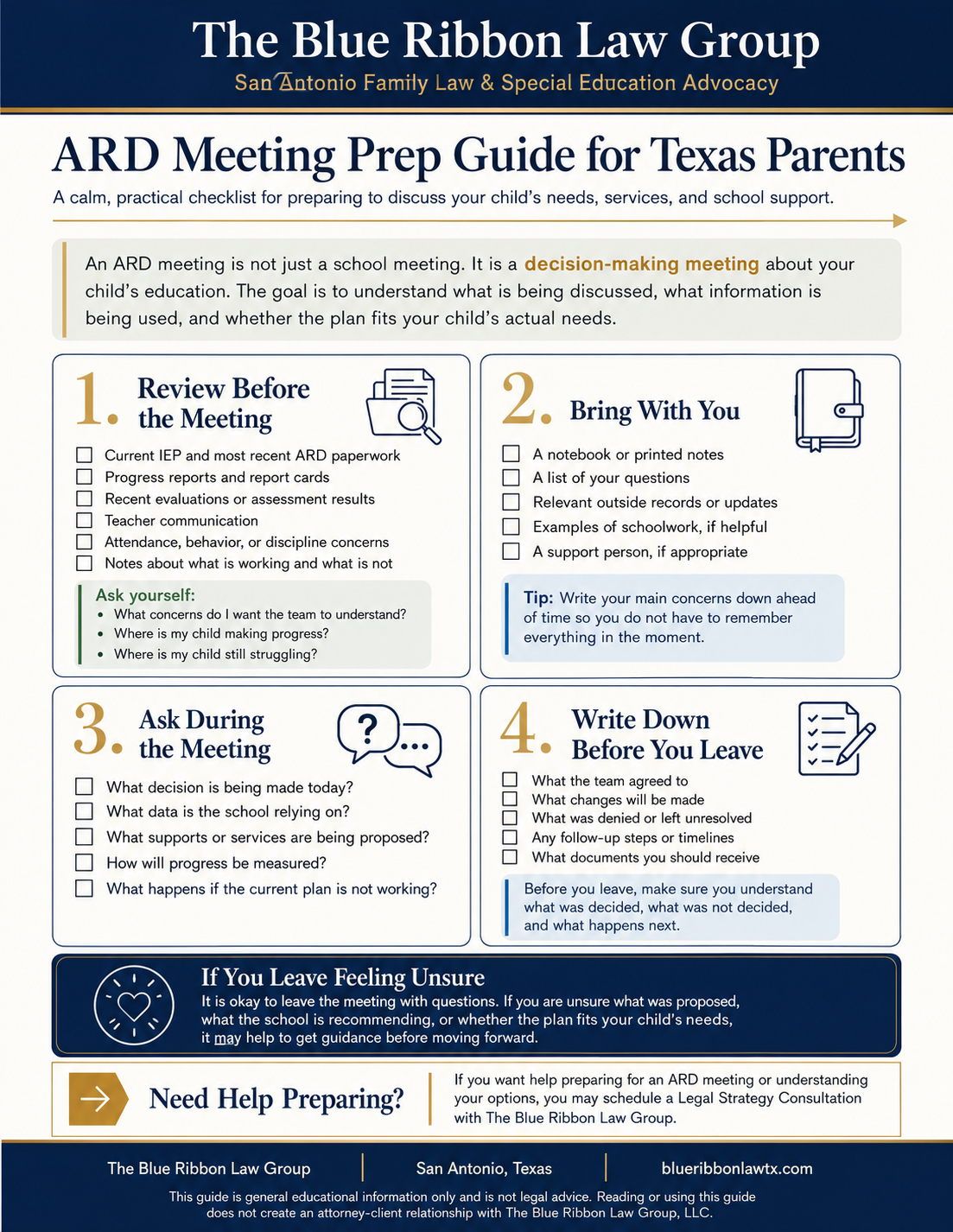
Download the ARD Meeting Prep Pack in English or Spanish
The complimentary ARD Meeting Prep Pack for Texas Parents is available in both English and Spanish. Each version includes the same two printable pages:
Page 1: ARD Meeting Prep Guide
Use it before the meeting to review:
Records to consider
Items to bring
Questions to ask
Information to write down before leaving
Page 2: ARD Meeting Notes & Decision Page
Use it during the meeting to track:
Your three main concerns
Information you need explained
Questions you need answered
Decisions made
Unresolved issues
Responsibilities and follow-up dates
Choose the version you would like to download:
Download the English ARD Meeting Prep Pack (PDF)
Descargar la Guía de Preparación para la Reunión ARD en Español (PDF)
When Additional Guidance May Help
Additional guidance may be useful when:
You are preparing for an important or complicated ARD meeting
The school has provided new evaluations or proposed IEP language
Your child is not making expected progress
You and the school understand the available information differently
You are unsure what a proposed goal, service, accommodation, or placement would mean in practice
Significant behavior, discipline, communication, or access concerns are involved
You need help identifying the decisions that matter most
You want to prepare questions before responding to a proposal
Seeking guidance does not necessarily mean beginning an adversarial process.
Sometimes the most valuable support is help reviewing the information, organizing the concerns, and preparing for a clearer conversation.
Prepare With Greater Clarity
If you are preparing for an ARD meeting, reviewing proposed IEP language, or trying to understand whether the school’s plan fits your child’s needs, The Blue Ribbon Law Group’s special education advocacy services can help you slow the moment down and think through your next steps.
You may request a Legal Strategy Consultation to discuss your situation and prepare with greater clarity. Learn more about Blue Ribbon’s calm, structured approach before deciding whether to move forward.
Request a Legal Strategy Consultation
Frequently Asked Questions About Preparing for an ARD Meeting
What should a parent bring to an ARD meeting?
Bring the current IEP, recent progress information, your written concerns and questions, relevant outside records, representative schoolwork when useful, and a page for recording decisions and follow-up. You do not need to bring every record you have.
Can a parent bring someone to an ARD meeting?
A parent may invite another person who has knowledge or special expertise regarding the child. That might include an advocate, provider, family member, or another appropriate support person.
What should I ask about an IEP goal?
Ask what current need the goal addresses, what skill will be measured, how progress will be measured, how frequently information will be collected, and when the results will be reported.
What should I do if I do not understand the school’s proposal?
Ask the committee to explain what is being proposed, the information supporting it, where the decision will appear in the paperwork, when it would begin, and how the team will evaluate whether it is working. Individual circumstances and timelines vary, so additional guidance may be helpful when an important issue remains unclear.
What should I write down before the meeting ends?
Write down what was decided, what remains unresolved, who is responsible for each follow-up step, what documents you should receive, and any dates connected to implementation or another meeting.
Author note
Karis Joi Johnson is a Texas attorney and former special education educator and district-level special education, Section 504, and intervention coordinator. Through The Blue Ribbon Law Group, she helps parents understand the decisions in front of them, organize their concerns, and prepare for thoughtful next steps.
Sources and Additional Parent Resources
Disclaimer: This information is general educational information only and is not legal advice. Reading this post or downloading the accompanying materials does not create an attorney-client relationship with The Blue Ribbon Law Group, PLLC. Every education matter depends on the specific facts, school records, timelines, and legal issues involved.